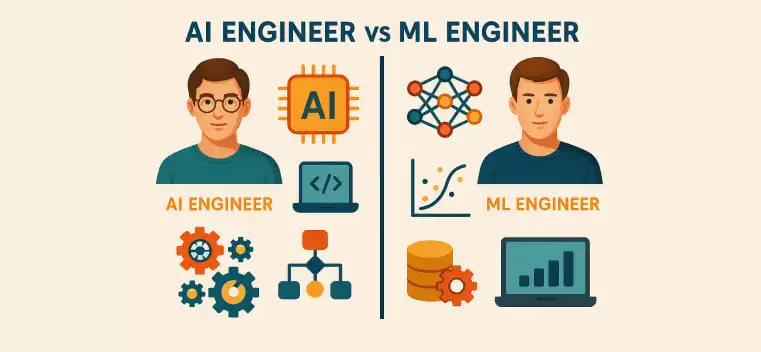
Bridging the gap between theoretical data science and enterprise-grade software delivery is where AI and Machine Learning Engineers thrive. While data scientists focus on statistical exploration and prototype development, ML Engineers build high-throughput prediction pipelines, optimize Large Language Models (LLMs), and integrate production-grade neural networks into real-time applications. This comprehensive breakdown covers model deployment architecture, MLOps tooling, professional learning pathways, and high-paying remote job hubs.
The Machine Learning Lifecycle: Core Engineering Domains
AI Engineering spans three distinct operational layers that transform raw algorithms into scalable cloud services:
1. Data Pipeline & Feature Engineering
Building automated ETL data pipelines, processing unstructured datasets, managing feature stores (e.g., Feast), and preparing training vectors for real-time model inference.
2. Model Architecture & Fine-Tuning
Selecting Transformer architectures, fine-tuning foundation models using LoRA/PEFT techniques, training custom neural networks, and quantizing weights for low-latency performance.
3. MLOps & Production Deployment
Deploying endpoints using Docker and Kubernetes, setting up continuous training (CT) loops, tracking model drift with MLflow, and maintaining GPU cluster utilization.
Key Machine Learning Tooling & Technical Frameworks
Professional ML engineers leverage industry-standard libraries and cloud infrastructure tools:
Skill Development Pathway: From Code to Deployment
Phase 1 (Foundations): Advanced Python, Data Structures, Linear Algebra, and Calculus for Machine Learning.
Phase 2 (Core Models): Supervised/Unsupervised learning with Scikit-Learn, XGBoost, and classical statistics.
Phase 3 (Deep Learning & Generative AI): Computer Vision, Transformer models, Embeddings, and Vector Search (Pinecone/Weaviate).
Phase 4 (Production MLOps): CI/CD for ML, REST API deployment (FastAPI), GPU optimization (TensorRT), and Cloud ML Services (AWS SageMaker / GCP Vertex AI).
Direct AI Engineering Hiring Platforms & Remote Contracts
High-paying AI engineering roles, LLM integration contracts, and MLOps positions are actively recruited through these specialized portals:
- Turing AI Engineering Portal: Connect with global tech enterprises seeking vetting AI/ML engineers for long-term remote contracts.
→ Apply as a Remote AI Engineer on Turing - Wellfound AI Startups Hub: Apply directly to fast-growing startups building generative AI and LLM products.
→ Browse Remote AI Startup Openings on Wellfound - Toptal Machine Learning Network: Elite freelance network hiring top-tier ML engineers and data pipeline specialists.
→ Join Toptal as a Freelance ML Specialist - Upwork AI & Machine Learning Hub: Bid on fine-tuning projects, OpenAI API integrations, and vector database setups globally.
→ Explore AI & Machine Learning Contracts on Upwork
Remote Market Value & Compensation Metrics
AI Engineering remains among the highest-paid technical disciplines globally due to a high demand-to-supply ratio. Remote compensation standards reflect these specialized metrics:
- Contract Rates: Experienced remote AI developers command $60 to $150+ per hour for model optimization and RAG system integration.
- Infrastructure Autonomy: Developers operate through remote GPU cloud instances (AWS EC2, RunPod, Lambda Labs) and cloud-native development environments.
- Asynchronous Collaboration: Deliverables center around clear code architecture, model evaluations, API performance benchmarks, and deployment documentation.
About the Author