IELTS vs TOEFL vs Duolingo: Comprehensive Acceptance, Difficulty, Cost & Strategy Guide
Demonstrating English language proficiency is a foundational requirement for international students applying to English-taught degree programs worldwide. Choosing between the International English Language Testing System (IELTS), the Test of English as a Foreign Language (TOEFL iBT), and the Duolingo English Test (DET) can significantly impact your academic roadmap, budget, and preparation timeline. This guide delivers an objective, data-driven comparison across global university acceptance, testing mechanics, difficulty, and cost structures to help you select the optimal exam for your university applications.
1. Side-by-Side Architectural Comparison
Official testing standards, administration frameworks, and delivery modes vary across all three testing bodies. Direct test policies can be referenced via the official IELTS Portal, ETS TOEFL Portal, and Duolingo English Test Portal:
| Evaluation Dimension | IELTS Academic | TOEFL iBT | Duolingo English Test (DET) |
|---|---|---|---|
| Global Acceptance | 12,500+ institutions worldwide (Gold standard in UK, Australia, Canada, Europe) | 13,000+ institutions worldwide (Gold standard in the United States & Canada) | 5,000+ programs (Rapid adoption in North America; selectively accepted in Europe/UK) |
| Test Format & Delivery | Computer-delivered or Paper-based at certified test centers | Computer-delivered at certified test centers (or Home Edition) | 100% Online, computer-adaptive, proctored remotely at home |
| Duration | ~2 Hours 45 Minutes | ~2 Hours (Streamlined format) | ~1 Hour (1 hour total testing time) |
| Scoring System | Band scale from 0 to 9.0 (0.5 increments) | Total score from 0 to 120 (4 sections, 0–30 each) | Overall score from 10 to 160 (Subscores: Literacy, Comprehension, Conversation, Production) |
| Cost Structure | $220 – $300 USD (Varies by country) | $190 – $270 USD (Varies by region) | $65 USD (Includes 40 free score reports to universities) |
| Results Turnaround | 3 to 5 days (Computer) / 13 days (Paper) | 4 to 8 days post-test | 2 days (48 hours) max |
2. Relative Difficulty & Structural Nuances
While all three tests measure standard academic English (CEFR alignment from B1 to C2), their structural presentation and cognitive demands differ significantly:
- IELTS Academic (Human-Centric & Varied Accents):
- Speaking: Conducted as a face-to-face interview with a real human examiner (either in-person or via video call). Ideal for test-takers who perform better interacting with people rather than talking to a computer screen.
- Listening & Reading: Uses authentic British, Australian, and North American accents with diverse question types (diagram labeling, multiple choice, matching headings, short answers).
- TOEFL iBT (Integrated Academic Focus):
- Academic Integration: Heavily tests combined skills. For example, you must read a passage, listen to a campus lecture, and synthesize both in a spoken or written response.
- Computer Focus: All responses (including Speaking) are recorded via a headset microphone. Demands fast typing skills and comfort with dense, North American style university lecture recordings.
- Duolingo English Test (Computer-Adaptive Mechanics):
- Adaptive Algorithm: Question difficulty auto-adjusts in real time based on whether previous answers were correct or incorrect.
- Rapid-Fire Modules: Focuses on micro-tasks such as identifying real English words from fake ones, dictation, describing images, and answering short spontaneous prompts.
Explore Global Fully Funded Study Programs:
Ready to use your test scores for university admission? Check out our step-by-step guides for the U.S. Fulbright Foreign Student Program, the Gates Cambridge Scholarship, and the Global Korea Scholarship (GKS).
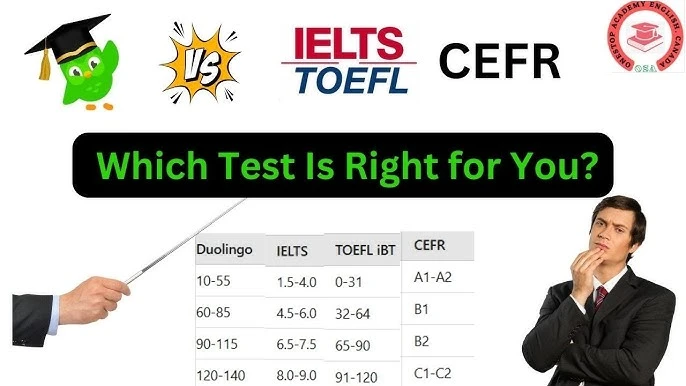
3. Score Equivalence & Conversion Reference Matrix
Universities typically publish minimum entry score thresholds across all three exams based on official concordance tables:
| Target CEFR Level | IELTS Band | TOEFL iBT Score | Duolingo (DET) Score |
|---|---|---|---|
| C2 (Expert Proficiency) | 8.5 – 9.0 | 115 – 120 | 150 – 160 |
| C1 (Advanced Entry) | 7.0 – 8.0 | 94 – 114 | 125 – 145 |
| B2 (Standard Undergraduate/Master’s) | 5.5 – 6.5 | 46 – 93 | 95 – 120 |
4. Decision Strategy: Which Test Should You Take?
Choose IELTS Academic if: You are applying to UK, Canadian, Australian, or European universities, prefer interacting with human examiners for speaking, and are comfortable with diverse English accents.
Choose TOEFL iBT if: You are aiming primarily for North American universities, have high typing speed, excel at integrated listening-reading-speaking academic tasks, and prefer recording responses via microphone.
Choose Duolingo English Test (DET) if: You need fast results (48 hours), have a constrained budget ($65 vs $200+), need to take the test immediately from home, and your target universities explicitly accept DET scores.
About the Author